As electric vehicle adoption continues to grow, the demand for flexible charging services is increasing across cities, highways, parking areas, and commercial locations. However, EV drivers may still encounter situations where fixed charging stations are unavailable, damaged, or too far away. In these circumstances, a mobile EV charging energy storage system can provide a flexible charging option for emergency rescue and roadside assistance. By combining battery storage with high-power DC charging, mobile equipment can deliver temporary charging support without depending entirely on fixed grid infrastructure.
How Mobile Energy Storage Supports Roadside Assistance
Traditional roadside assistance often focuses on vehicle recovery, towing, and basic repairs. Nevertheless, as more drivers switch to electric vehicles, charging support has become another important service requirement. A mobile charging unit can travel to the vehicle’s location and provide additional energy when the battery level is too low to reach the nearest charging station.
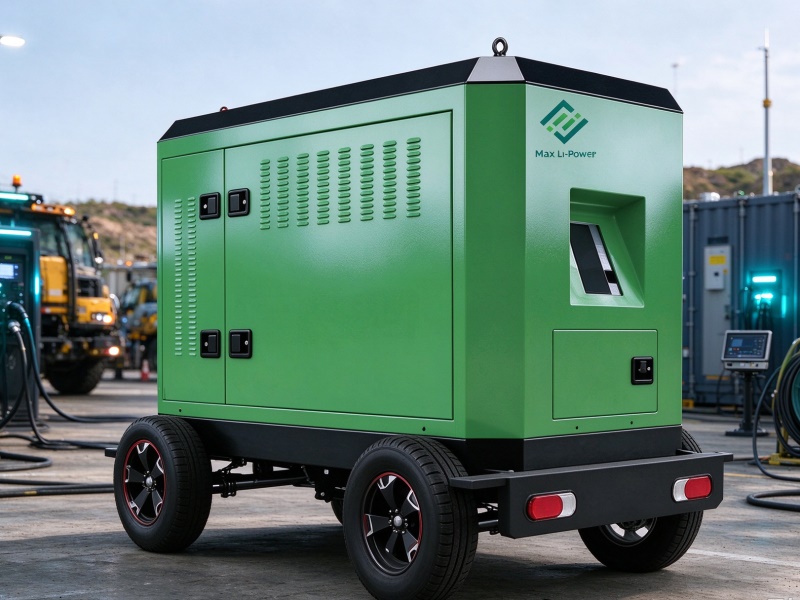
The 80kW / 106kWh mobile EV charging and energy storage system is designed for this type of flexible application. It combines an 80kW DC charging output with 106kWh of battery storage capacity, allowing service operators to provide charging support in different locations. Moreover, its compact structure and convenient transportation make it suitable for temporary charging needs in urban areas, roadside assistance operations, and small commercial applications.
Key Features of an 80kW / 106kWh Mobile Charging System
The system’s performance depends on its charging output, available energy capacity, deployment flexibility, and safety functions. Together, these features help determine whether the equipment can meet the needs of emergency services and temporary charging projects. The following table summarizes its main product characteristics.
| Feature |
Product Information |
Application Benefit |
| DC Charging Output |
80kW |
Supports high-power DC charging |
| Battery Capacity |
106kWh |
Provides stored energy for mobile charging |
| System Type |
Mobile EV charging and energy storage system |
Combines energy storage and charging functions |
| Deployment |
Compact and easy to transport |
Supports temporary and mobile applications |
| Charging Scenarios |
Off-grid and temporary charging |
Reduces dependence on fixed charging infrastructure |
| Battery Protection |
Advanced BMS and multi-layer safety protection |
Supports battery monitoring and operational safety |
| Testing |
Factory Acceptance Testing (FAT) |
Helps verify system performance and safety before delivery |
With these capabilities, the equipment can serve as a mobile battery charging container for locations that need temporary EV charging support. However, actual charging duration and the number of vehicles served will depend on vehicle battery size, charging conditions, conversion losses, and the system’s available energy.
Emergency Rescue and Roadside Assistance Applications
Emergency charging requirements can vary significantly depending on location, vehicle type, and service conditions. Therefore, mobile energy storage equipment can provide additional flexibility for service providers that need to respond to changing charging demands.
Common application scenarios include:
- Highway roadside assistance: Provides temporary charging support for EVs that cannot reach the next charging station.
- Urban emergency services: Supplies mobile charging support in areas where fixed charging facilities are temporarily unavailable.
- Temporary charging stations: Support events, construction areas, and temporary parking locations with changing charging requirements.
- Residential communities: Offers additional charging options when existing charging facilities cannot meet temporary demand.
- Commercial vehicle support: Provides mobile charging services for suitable commercial EVs and fleet operations.
In addition, mobile charging equipment can support off-grid battery storage applications where grid access is limited or unavailable. This flexibility makes it useful for temporary charging operations, although project planners should assess energy demand, charging frequency, and replenishment arrangements before deployment.
Battery Safety and Intelligent Management
Battery safety is a major consideration in mobile energy storage because the equipment may operate across different locations and environmental conditions. The 80kW / 106kWh system incorporates advanced battery management technology, intelligent monitoring functions, and multiple safety protection systems. These features help monitor battery operation and support safer charging and discharging processes.
Furthermore, each system undergoes strict Factory Acceptance Testing (FAT) procedures before delivery. These tests are intended to verify charging performance, battery safety, and operational reliability. For emergency rescue operators, checking the manufacturer’s testing documentation and operating instructions is also important before putting the equipment into service.
A Cleaner Alternative to Conventional Fuel-Powered Solutions
Fuel-powered generators have traditionally supported temporary power requirements at remote locations and emergency service sites. However, they produce exhaust emissions and operating noise, which may be inconvenient in residential communities, urban parking areas, and other noise-sensitive environments. By using stored electrical energy, a mobile EV charging energy storage system offers a quieter alternative for EV charging applications and can help reduce reliance on fuel-powered equipment. For commercial operators, a battery energy storage system can also provide a flexible approach to temporary power management. Depending on the energy source and charging arrangements, stored electricity may be replenished through suitable grid connections or renewable energy configurations. Therefore, operators should evaluate the available energy supply and charging schedule to determine how the system fits into their service operations.
Supporting Flexible Commercial EV Charging Infrastructure
As EV charging demand expands, service providers need solutions that can adapt to different locations and project requirements. A mobile unit can complement fixed charging stations by providing temporary support where permanent infrastructure is limited or unavailable. Meanwhile, commercial battery storage can help operators plan energy availability for mobile charging services and other suitable power applications. For larger projects, scalable ESS systems may offer additional flexibility by allowing energy storage capacity and equipment configurations to match project requirements. However, system expansion and parallel operation should always follow the manufacturer’s supported configuration. Businesses should also evaluate charging output, usable energy, deployment conditions, and maintenance requirements before selecting equipment.
Conclusion
Emergency rescue and roadside assistance services increasingly need flexible charging options as electric vehicle use continues to expand. An 80kW / 106kWh mobile charging system combines high-power DC output, battery storage, convenient transportation, intelligent monitoring, and multiple safety protections to support temporary EV charging applications. Its compact design and off-grid charging capability make it suitable for urban support, roadside assistance, temporary charging stations, and selected commercial projects. For businesses planning to expand their mobile EV charging services, a mobile EV charging energy storage system can complement fixed charging infrastructure and provide additional deployment flexibility. Max Li-Power offers energy storage solutions for commercial applications, helping project developers evaluate suitable configurations according to their charging requirements and operating scenarios.



 10Nov
 by